
June 13, 2026 · practice mastery · relationships · sales
People Skills Are the Last Real Edge
Your competitor has the same products, software, and rates. What they can't copy is how a client feels sitting across from you. A practical playbook drawn from Carnegie and Giblin.

The misunderstood truth: Clients don't buy the plan. They buy the person they trust to explain it.
Every advisor eventually learns the hard lesson: the best strategy in the room loses to the advisor who is easiest to trust. You can be right about the Roth conversion, the sequence-of-returns risk, and the beneficiary error in their trust — and still watch the prospect walk out and do nothing. Not because your analysis was wrong. Because you never earned the relationship that lets analysis matter.
Two short books have been quietly teaching this for decades. One is famous; the other most advisors have never heard of. Together they form a complete playbook for the part of this business no designation tests you on.
How to Win Friends and Influence People
Dale Carnegie · 1936
The original classic. Carnegie's premise is simple and uncomfortable: almost no one is moved by logic alone. People are creatures of emotion, pride, and the deep need to feel important — and the advisor who works with that nature wins.
Skill With People
Les Giblin · 1968
The 50-page distillation. Giblin took Carnegie's ideas and boiled them into pocket-sized, do-it-Monday techniques: how to listen, agree, make people feel important, and persuade — without the fluff.
Start Where Both Books Start
Human nature, not technique. Before the tactics, both authors plant the same foundation. Get these three truths wrong and every "technique" on top of them becomes manipulation. Get them right and the techniques become unnecessary — they just describe what you'd do naturally.
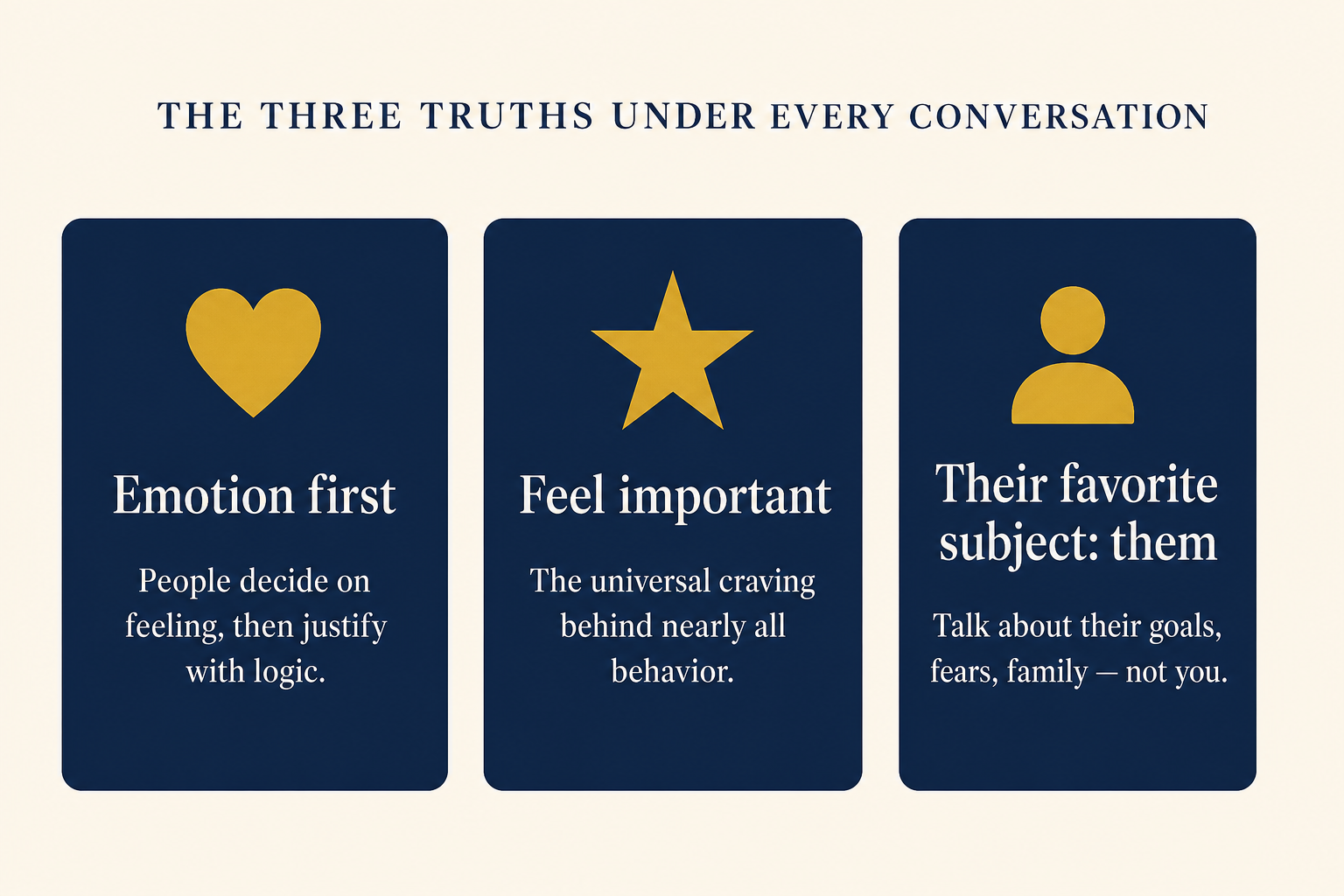
- Emotion first. People decide on feeling, then justify with logic.
- Feel important. The universal craving behind nearly all behavior.
- Their favorite subject is themselves. Talk about their goals, fears, and family — not you.
Notice how naturally this maps to what you already do well. Your discovery process — asking about their goals, their fears, the family they want to protect — isn't a sales tactic. It's the single most powerful application of all three truths at once. You're letting the client talk about the most interesting subject in the world, while you make them feel like the most important person in the room.
Carnegie, Translated for the Advisor's Chair
How to Win Friends and Influence People is organized into four movements. Here's each one rewritten for the seminar room and the discovery meeting — not the 1936 sales floor.
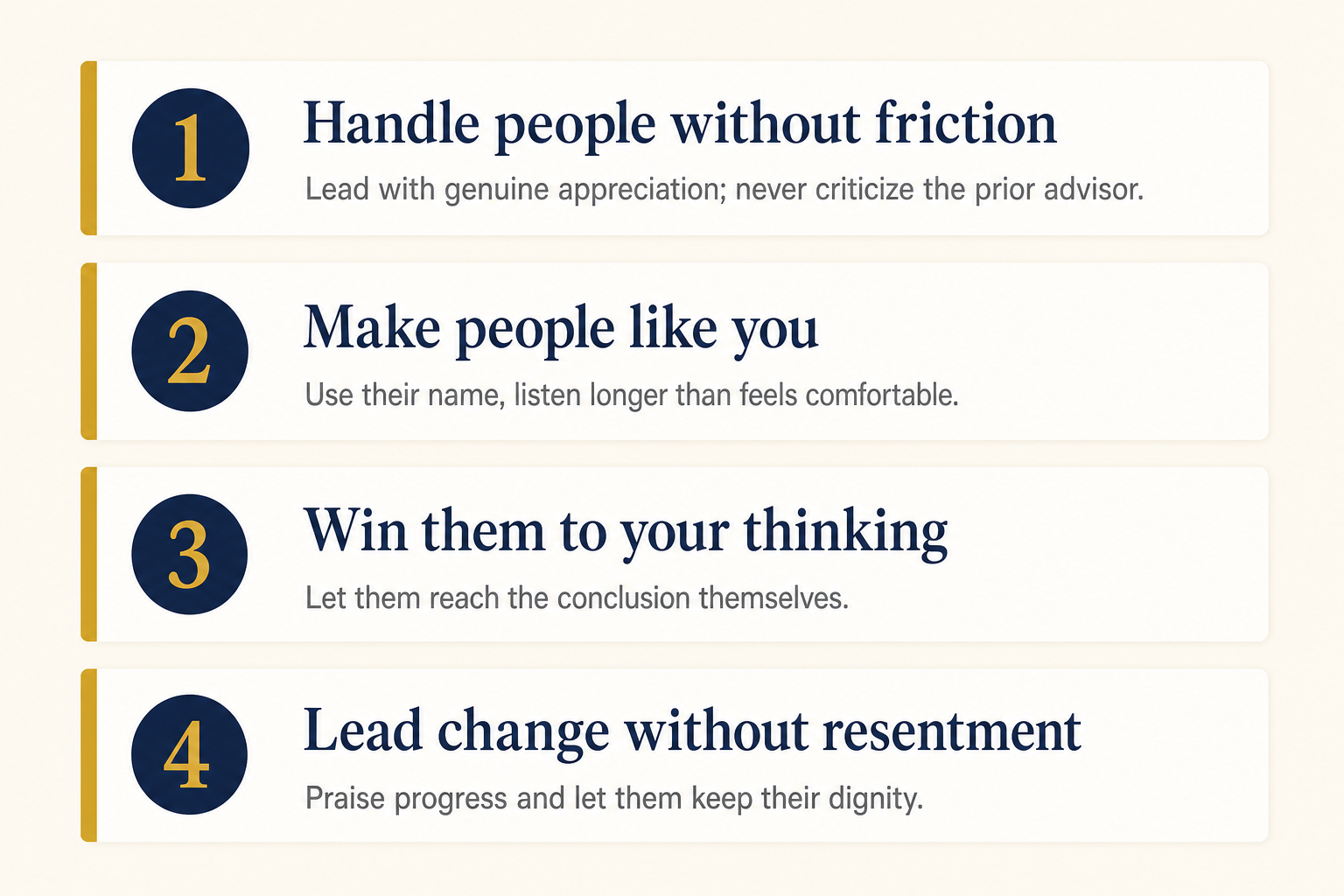
- Handle people without friction. Don't criticize the prior advisor or the bad 401(k). Lead with genuine appreciation.
- Make people like you. Use their name, listen longer than feels comfortable, ask about what they care about.
- Win them to your thinking. Let them reach the conclusion. Ask the question that makes the gap obvious to them.
- Lead change without resentment. Praise progress, make the next step feel easy, and let them keep their dignity.
"A person convinced against their will is of the same opinion still." The plan you talk someone into is the plan they'll talk themselves out of by next Tuesday.
Giblin's Skills You Can Use Monday
Where Carnegie gives you the philosophy, Giblin gives you the moves. Skill With People is barely 50 pages, and that's the point — Giblin believed knowledge is worthless until it's used. These six are the ones that matter most in your work.
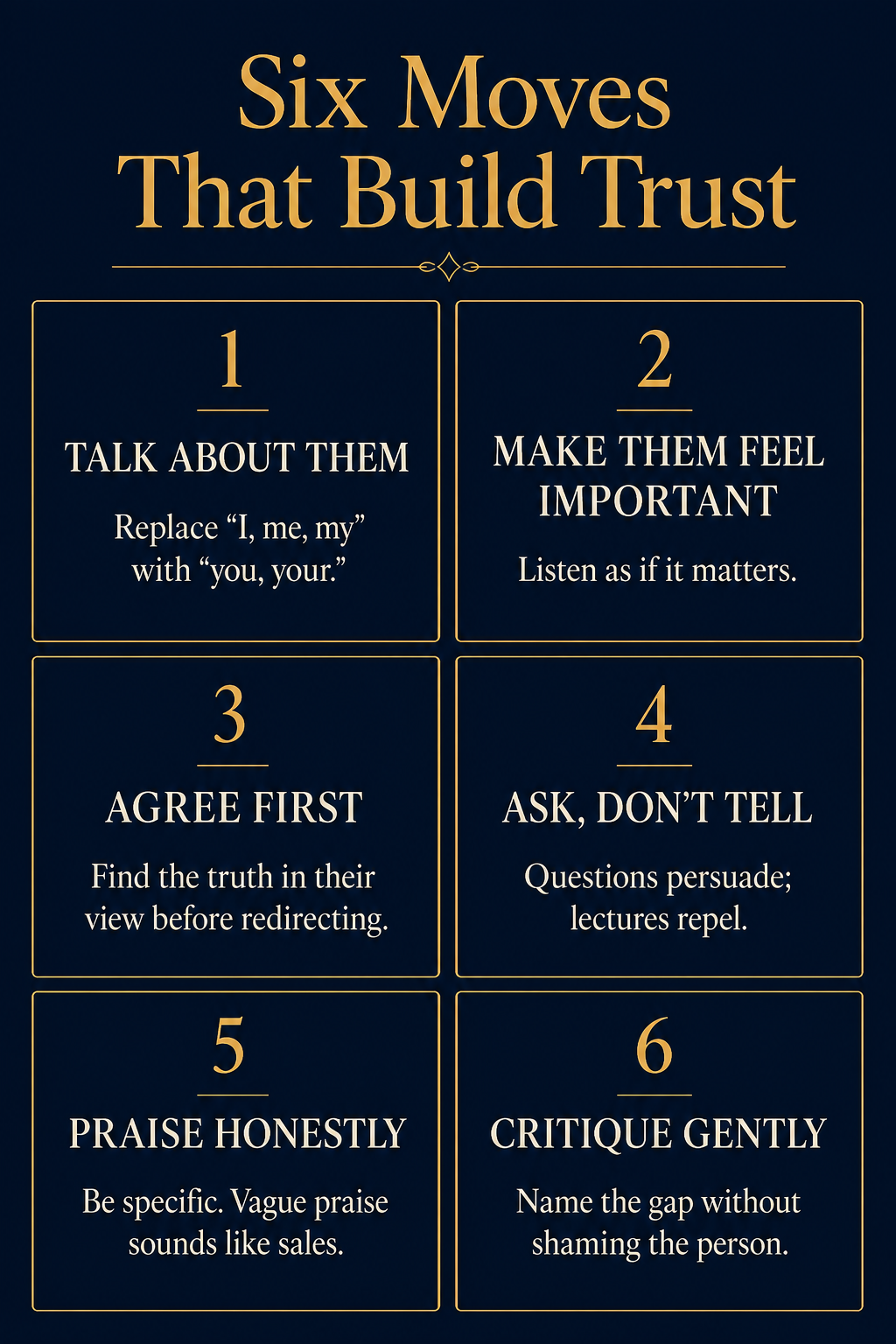
- Talk about them. Replace "I, me, my" with "you, your."
- Make them feel important. Listen as if it matters.
- Agree first. Find the truth in their view before redirecting.
- Ask, don't tell. Questions persuade; lectures repel.
- Praise honestly. Be specific. Vague praise sounds like sales.
- Critique gently. Name the gap without shaming the person.
The Line You Must Not Cross
Influence vs. manipulation. Here's where most "people skills" training goes wrong, and where your fiduciary standing makes this non-negotiable. The exact same words — the warm listening, the well-placed question, the sincere praise — can be used to serve the client or to serve yourself. The technique is identical. The intent is everything.
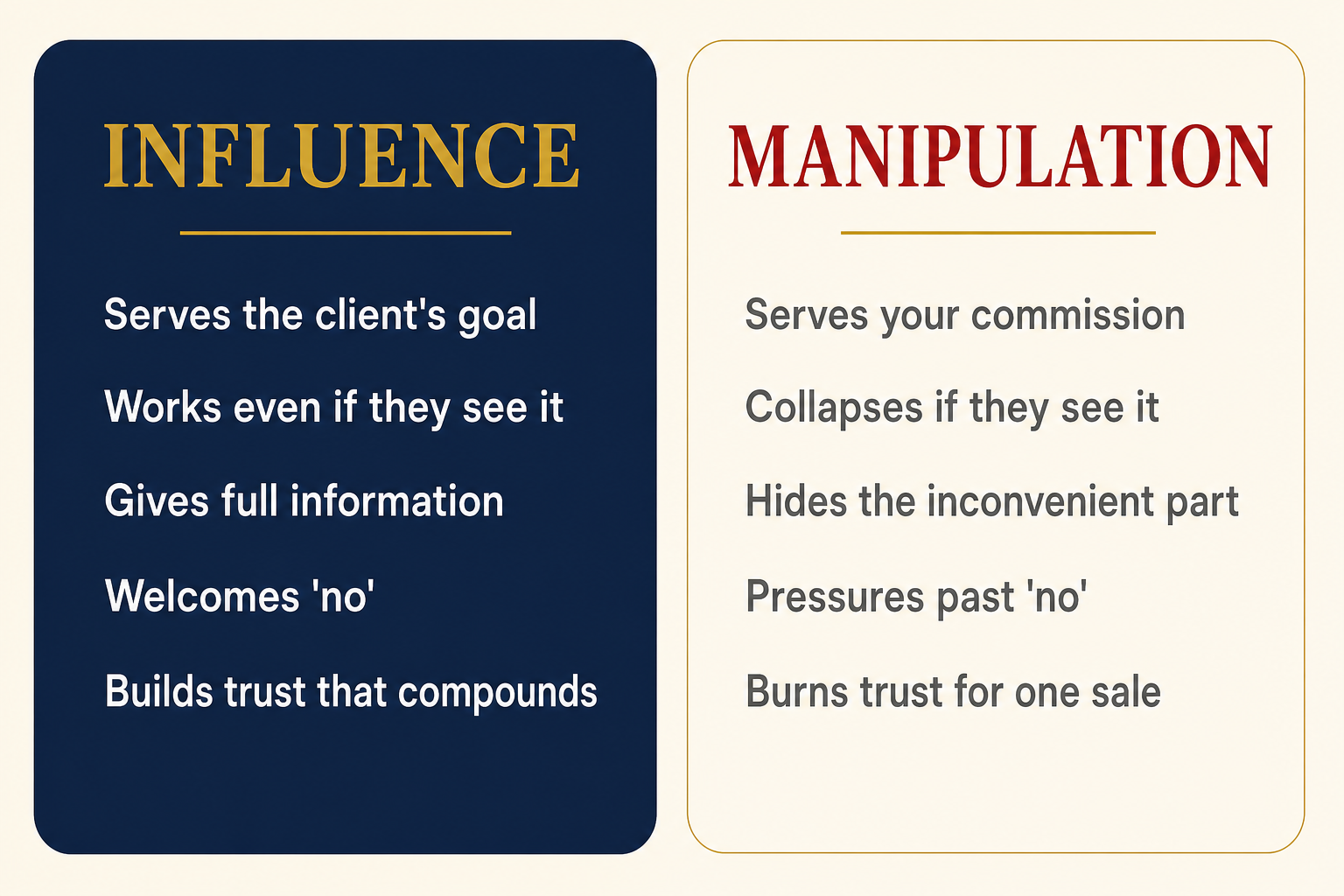
The Advisor Ascend test: If a technique only works because the client doesn't notice it, it's manipulation — and it's a fiduciary problem waiting to happen. Real influence survives full transparency. You should be able to say, out loud, "I'm asking you these questions so we both understand what matters most to you," and have it strengthen the moment, not break it.
This is why these two books fit our philosophy so cleanly. We win by teaching, not selling. Carnegie and Giblin aren't teaching you to trick anyone — they're teaching you to remove the friction between a person and a decision that's already in their interest. That's the whole job.
My #1 Goal in Every First Meeting
Make a friend. Earn the next conversation. Here's the goal I bring into every first appointment, and it's probably not what you'd expect from a tax and retirement specialist. My number one job in that meeting is not to close. It's not to present a plan. It's not to handle an objection. It's this: make a new friend and set a follow-up.
That's it. If I leave with a friend and a date on the calendar, I won. The plan, the products, the strategy — all of that has room to happen, because I earned the one thing that makes it possible: a second conversation with someone who likes and trusts me. Try to do the whole job in meeting one and you'll usually do none of it.
The legendary coach Art Williams put it best: every person walks around with a big flashing sign around their neck that reads "I AM SPECIAL." Your job is to read it out loud.
Williams understood something the technicians miss. Everyone you sit across from — the retired teacher, the business owner, the widow sorting out an estate — is silently broadcasting the same need: make me feel like I matter. The advisor who reads that sign and answers it sincerely doesn't have to chase anybody. People come back to the person who made them feel special.
That's also why "make a friend, set a follow-up" works. You can't fake your way into a friendship in 45 minutes, and you shouldn't try. But you can make someone feel genuinely seen — and that earns you the right to the second meeting, where the real planning begins.
- Make a new friend. Read their sign. Be sincerely interested, listen longer than feels natural, and make them feel like the most important person in the room — because to them, they are.
- Set the follow-up. Leave with a date on the calendar, not a signature on a form. Momentum and trust win the relationship; the relationship wins everything that comes after.
Put It to Work This Week
Pick one client conversation and run it through these five moves. You'll feel the difference in a single meeting.
- Talk 30% of the time. Track it. If you're talking more than a third of a discovery meeting, you're lecturing, not connecting.
- Lead with their goal, in their words. Open by repeating back what they told you matters — the grandkids, the cabin, never being a burden.
- Replace one statement with a question. Instead of "You need to fix this," ask "What happens to your family if this isn't handled?"
- Find the truth in their objection first. "You're right to be cautious about that — here's what most people don't know about it."
- End with one easy next step. Not the whole plan. The single small action that keeps dignity intact and momentum alive.
Master these and you stop competing on rate sheets and product features. You start competing on the one thing no carrier, robo-advisor, or AI can hand a prospect: the feeling of being truly understood by someone they trust. That's the edge that built every great practice — and it's still available to anyone willing to read two short books and actually use them.